
By Neue Zürcher Zeitung –
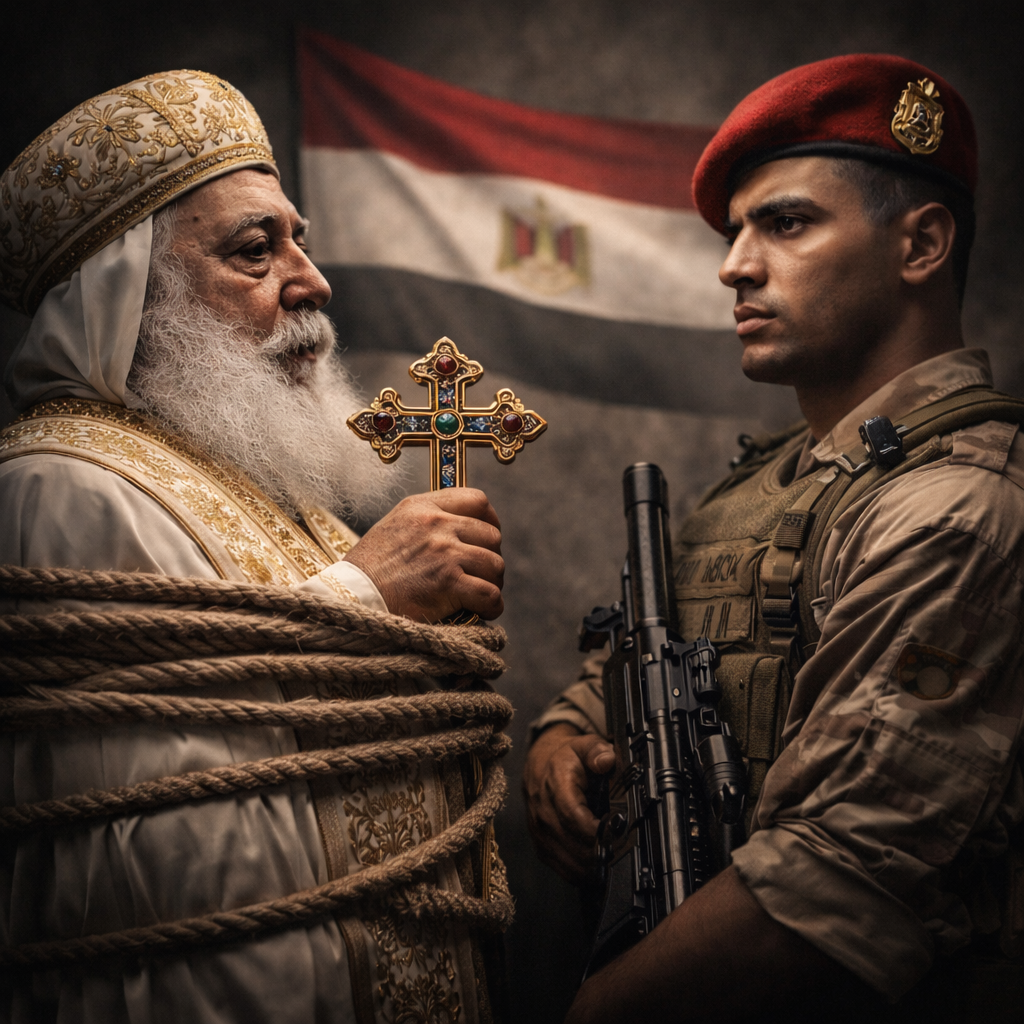
President Sisi builds cathedrals and imprisons Christians. Egypt’s Copts are publicly honored—yet remain second-class citizens. A look at a system that grants the Christian minority protection, but not equality.
On January 7, 2026, as Christians across Egypt celebrated Christmas according to the Orthodox calendar, President Abdel Fattah al-Sisi personally conveyed Christmas greetings to the faithful in the government-built Cathedral of the Nativity of Christ. Just four days earlier, the same government had sentenced a Christian named Augustinos Samaan to five years of forced labor. His offense: in online debates with Muslims, he had defended the Christian faith.
These two events illustrate the paradox facing Egypt’s Christians, most of whom are Copts. Even when publicly honored by their country’s authoritarian president, they remain a minority under scrutiny—protected, but only so long as they do not disturb the majority.
The Largest Christian Community in the Middle East
An estimated twelve million Christians live in Egypt, roughly 10 percent of the population. The exact number is disputed: official statistics put it at about 5 percent, while church representatives say the government figure is too low and estimate up to 15 percent. Regardless of the precise number, Christians in Egypt form by far the largest Christian community in the Middle East—in a region where there are ever fewer places where Christians can live safely.
Conversion from Islam to Christianity is almost impossible, while the reverse path is strikingly easy.
Copts are strongly represented in business, science, and the arts, and their cultural influence on Egyptian society is considerable. Arabic-speaking Christians around the world follow religious programming broadcast via satellite from Egypt. Around 90 percent of Christians in Egypt belong to the Coptic Orthodox Church, which traces its origins to the Evangelist Mark. The remaining 10 percent belong to the Coptic Catholic Church, the Greek Orthodox Church, or Protestant congregations.
The Copts are neither immigrants nor recent converts to Christianity; they are deeply rooted historically in their land. From the third century until the Middle Ages, Egypt was predominantly Christian. The word “Copt” once simply meant “Egyptian.” Modern genetic studies show that almost all Egyptians are somehow related to the inhabitants of the ancient Egyptian kingdoms—the Copts even more so than their Muslim compatriots.
President Sisi likes to present himself as a protector of Egypt’s Coptic Christians. In reality, however, they suffer from legal inequality, social discrimination, and also violence. The new Cathedral of the Nativity of Christ is a symbol of this contradiction. The largest church in the Middle East, with space for about 8,000 worshippers, stands in Egypt’s new administrative capital, 45 kilometers east of Cairo in the desert, making it difficult for ordinary citizens to reach. At the same time, Egyptian law makes it extremely difficult to build new churches or renovate existing ones. Special permission from the governor is required.
Egypt’s legal system is oriented toward Islam. According to the constitution, Islam is the state religion, and the principles of Sharia are the main source of legislation. Muslim men may marry Christian women, but Christian men may not marry Muslim women. Children from mixed marriages are automatically considered Muslims. The religion of every citizen is registered by the state and recorded on identity cards. Conversion from Islam to Christianity is almost impossible; the reverse path, however, is remarkably easy.
The Dominance of Islam
This Kafkaesque system encourages a particular form of gender-based violence: the abduction and forced conversion of Christian girls and women. Alarmingly many disappear suddenly, only to reappear weeks later wearing a veil—converted to Islam under pressure and married to a Muslim man. Once a conversion is officially registered, there is almost no legal path back. Meanwhile, the perpetrators remain effectively unpunished.
When Christian communities are attacked by Muslim mobs—whether over disputes about church construction or interfaith relationships—Christians, especially in rural areas, can rarely count on police protection or the rule of law. Instead, authorities organize so-called “reconciliation sessions.” These usually end with the Christians apologizing for the alleged offense that led to the destruction of their homes, paying compensation to the Muslims, and then leaving the village.
Despite President Sisi’s demonstrative declarations that he stands with Christians, the dominance of Islam remains an unavoidable reality in Egypt.
Islamist groups in Egypt regard Christians as religious enemies of Islam and call for jihad against them. Between 2011 and 2018, extremists killed hundreds of Christians in a series of church bombings. In recent years such attacks have become less frequent. In this sense, Sisi’s claimed protection of the religious minority contains a measure of truth.
The former general, who came to power in 2013 through a coup against the government of Mohamed Morsi and the Muslim Brotherhood, has curbed Islamist groups with force—not out of love for Christians, but because the Islamists threatened his rule. Yet the regime does not protect Christians as equal citizens. Their protection comes with conditions: as long as they submit, violence against them remains within limits.
Unforgettable remains the horrific bombing of a church in Alexandria on January 1, 2011. A suicide bomber detonated himself during the New Year’s service, killing 23 people. In her book Copts at the Crossroads, political scientist Mariz Tadros argues that there is strong evidence that Egyptian security services helped organize the attack in order to silence the Copts. In the weeks before the bombing, church leaders had publicly criticized the government’s handling of the disappearance of a priest’s wife.
“Dhimmitude” Means Subordination
This relationship between Christians and a Muslim ruler has a name: “dhimmitude.” When Muslim rulers conquered Egypt in the seventh century, they promised Christians and Jews protection—but only on the condition that they submit as “dhimmis.” They had to pay special taxes, accept the supremacy of Sharia, and pledge loyalty to Muslim rulers. Violations could lead to collective punishment.
Compared with the persecution of Jews and Muslims in medieval Europe, this system of subordinate coexistence was long considered relatively tolerant. Today the formal dhimmi status has been removed from Egyptian law. What remains, however, is the mentality of “dhimmitude”—a relationship between Muslims and Christians shaped by this historical arrangement, with serious consequences to this day.
The historian Bat Ye’or, an Egyptian Jew, coined the term “dhimmitude.” As a child she experienced a Jewish community of 75,000 people in Egypt; today fewer than ten Jews remain. After the Suez War of 1956, Bat Ye’or’s family—along with the rest of Egypt’s Jewish population—was forced to flee the country, collectively punished and expelled for Israel’s attack.
In a similar manner, massacres of Egyptian Christians in recent decades—carried out either by the state or by Muslim extremists—have often been justified by accusing Christians of stepping out of line: criticizing the government, preventing Muslims from converting Christians, building churches, or committing other alleged violations.
To Western observers, the government’s treatment of the Copts appears glaringly contradictory. But Egypt’s rulers do not see it that way. In their view, Christians are not equal citizens but rather “dhimmis”—protected as long as they submit.
Coptic Christians have lived in Egypt for nearly two thousand years, and they will remain. It would be welcome if the country could transition to a society in which all citizens enjoy equal rights regardless of religion. For now, however, that remains little more than a pious hope.
_____________
Translated from: